
You may come across the word wondrand while reading about wound care, exploring an old text, or searching for an unfamiliar term online. It can be confusing because it does not have one widely recognized meaning in modern English.
In Dutch, wondrand refers to the edge or margin of a wound. In historical Scots, wondrand appears as a form of the verb wonder, meaning to feel surprise or amazement. The surrounding sentence – and the language it comes from – helps identify which meaning applies.
Wondrand at a Glance
| Context | Possible meaning |
|---|---|
| Dutch healthcare or wound care | The edge or margin of a wound |
| Historical Scots writing | A form of wonder, meaning to feel surprise or amazement |
| Modern English | Not a common standard English word; check the context |
1. What Does Wondrand Mean?
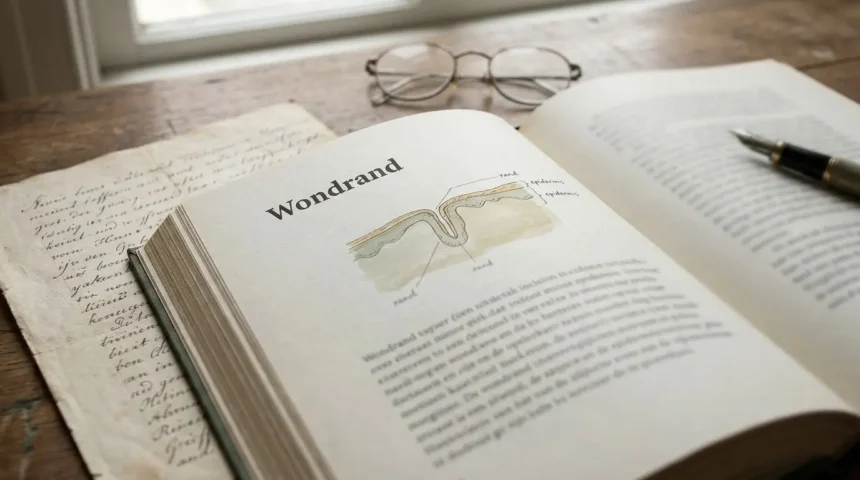
The clearest modern meaning is Dutch: wondrand means the edge of a wound. It describes the boundary where the injured area meets the surrounding skin. Dutch wound-care records use for information about the condition of a wound’s edges.
For example, in a Dutch medical note, the word is likely describing a wound feature—not naming a product, beauty treatment, or general condition.
2. Where Does the Dutch Meaning Come From?
The Dutch term combines two parts: wond, meaning “wound,” and rand, meaning “edge” or “border.” Together, they form a straightforward compound: the edge of a wound.
The Dutch healthcare information model uses as a specific data field for recording the condition of wound edges.
This is a useful distinction: wondrand names an anatomical area around an injury. By itself, it does not tell you whether the wound is healing normally or what care it needs.
3. What Does Wondrand Mean in Historical Scots?
The spelling also appears in the Dictionary of the Older Scottish Tongue. There, wondrand is shown as a form of the verb wondir—an older spelling related to wonder. In that historical context, it can mean feeling wonder, admiration, astonishment, or surprise.
This meaning is very different from the Dutch medical term. A passage describing someone looking on in amazement may use in the historical Scots sense.
4. Is Wondrand an English Word?
Wondrand is not a common word in modern English. If you see it in English-language content, it may be a borrowed Dutch term, a historical spelling, a name, or simply a typo. The meaning should not be guessed from the letters alone.
Check the sentence around it:
- A passage about wound care may use the Dutch meaning.
- An old Scottish text may use the historical meaning related to wonder.
- A modern product page or website may be using it as a name, which does not establish a dictionary meaning.
5. How to Tell Which Meaning Applies
Look for clues in the source. Medical notes, wound-care guides, or Dutch-language documents point toward “wound edge.” Older Scottish writing may use the word in a sentence about amazement or observation.
If the source is a brand, username, or website, treat as a proper name unless the publisher explains otherwise. A name can be invented or chosen for branding, so it may not follow either established meaning.
Conclusion
Wondrand has more than one possible interpretation. In Dutch, it means the edge of a wound and appears in wound-care contexts. In historical Scots, it is recorded as a form related to wonder. Since it is not a common modern English word, the safest way to understand it is to look at the language, date, and subject of the source.
Frequently Asked Questions
What does wondrand mean in Dutch?
It means the edge or margin of a wound. Dutch healthcare information uses to describe the condition of a wound’s edges.
Does wondrand mean “wondering”?
In a historical Scots text, wondrand appears as a form of wondir, an older form of wonder. In modern Dutch, it has a separate meaning: “wound edge.”
Is wondrand a medical diagnosis?
No. In Dutch wound-care records, it refers to the edge of a wound or information about its condition. The word alone does not identify a diagnosis or prescribe treatment.
Is wondrand used in everyday English?
It is not commonly used in everyday modern English. English readers are most likely to encounter it in Dutch-language or medical contexts, historical writing, or as a name.
Could Wondrand be a brand or website name?
Yes. A business or website may use as a name. That use does not automatically give it a standard dictionary meaning; check the organization’s own description.
Related reading: Color Stages of a Scar: A Complete Healing Guide
Our Editorial Approach
Beauty and self-care information should be clear and easy to use. Our goal is to help you understand your options and make more informed choices about your everyday routine.
Our articles are for educational purposes only and do not replace advice from a qualified healthcare professional.