
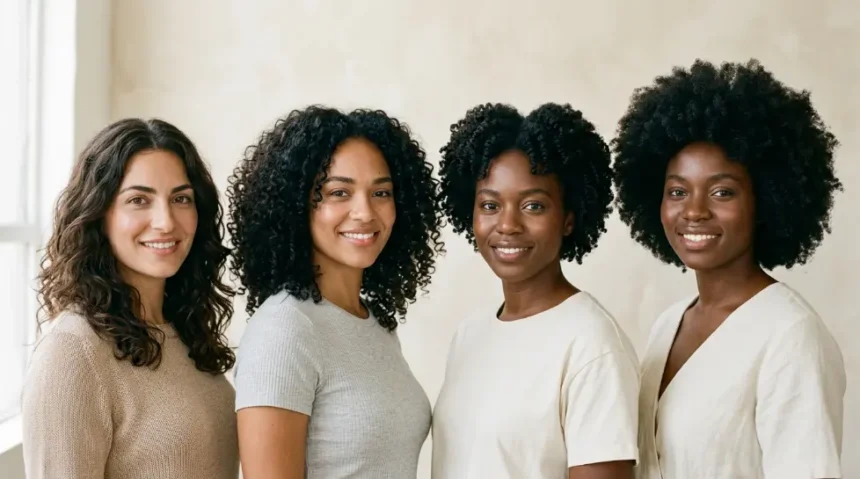
Curly hair types are commonly grouped from 2A to 4C. Type 2 describes wavy hair, Type 3 covers defined curls and ringlets, and Type 4 includes tight curls and coils. The letters A, B, and C describe how loose or tight the pattern appears within each group.
- How Does the Curl Pattern Chart Work?
- Curly Hair Types From 2A to 4C
- How to Identify Your Curl Type
- 1. Begin With Clean Hair
- 2. Skip Heavy Products
- 3. Let the Pattern Form Naturally
- 4. Check Several Areas
- 5. Observe More Than One Wash Day
- Curl Type Is Not the Same as Hair Porosity
- Curly Hair Care by Type
- How to Adjust a Routine That Isn’t Working
- Can Your Curl Pattern Change?
- Common Curl-Typing Mistakes
- Frequently Asked Questions
- Final Takeaway
Knowing your curl type can make choosing products and styling methods easier, but it’s only part of the picture. Your hair’s porosity, density, strand thickness, condition, and scalp needs may affect your routine just as much as the shape of your curls.
It’s also completely normal to have two or more curl patterns on the same head.
How Does the Curl Pattern Chart Work?

The familiar curl pattern chart is a visual guide, not a medical or scientific diagnosis. It gives people a shared way to describe wavy, curly, and coily hair.
Although curl classifications are convenient, researchers use several different systems to study hair shape and curvature. There is no single universal chart that captures every possible texture. A review of curly hair science explains that curl formation involves the structure and behavior of both the follicle and the growing hair fiber.
In the popular 2A to 4C system:
- Type 2 hair forms waves.
- Type 3 hair forms spirals or ringlets.
- Type 4 hair forms tight curls, coils, or angled bends.
- The letters A through C generally move from looser to tighter patterns.
Type 1 refers to straight hair, so it isn’t included in this curly hair guide.
Curly Hair Types From 2A to 4C
Use this chart as a starting point. Look at the natural shape of clean, dry hair rather than trying to match every strand perfectly.
| Hair type | What it usually looks like | Common behavior | Helpful care focus |
|---|---|---|---|
| 2A | Loose, stretched S-shaped waves | Can become flat or oily at the roots | Lightweight moisture and gentle volume |
| 2B | More defined S-waves, often beginning near the roots | May develop surface frizz | Light styling foam or gel |
| 2C | Strong waves with some loose spirals | Can be coarse, full, or easily weighed down | Moisture balanced with firm hold |
| 3A | Large, loose spiral curls | Curls may lose shape between washes | Lightweight curl definition |
| 3B | Springy, medium-size ringlets | Often needs more moisture and hold | Leave-in conditioner and gel |
| 3C | Tight, densely packed corkscrews | Prone to tangling and noticeable shrinkage | Slip, moisture, and careful detangling |
| 4A | Small, visible S-shaped coils | Strong definition with considerable shrinkage | Consistent conditioning and gentle styling |
| 4B | Tight curls with angled or zigzag bends | May appear less uniformly defined | Sectioned detangling and flexible hold |
| 4C | Very tight coils with a compact pattern | Significant shrinkage and fragile ends | Rich conditioning and low-manipulation styling |
These descriptions are tendencies, not rules. Type 2 hair isn’t always fine, and Type 4 hair isn’t always coarse. Any curl pattern can have fine, medium, or thick individual strands.
Type 2: Wavy Hair

Type 2 hair has a visible S shape but usually doesn’t form complete ringlets throughout the head.
Type 2A waves are the loosest and may appear almost straight near the roots. Heavy creams, butters, and oils can quickly make this pattern look flat.
Type 2B hair has stronger waves and often develops frizz around the crown. A light mousse or gel can add definition without removing movement.
Type 2C sits between wavy and curly. It may contain strong S-waves, loose spirals, or both. It generally needs more hold than 2A or 2B hair but can still become weighed down by overly rich products.
Type 3: Curly Hair
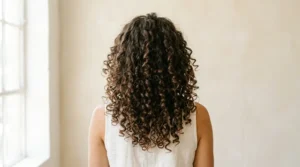
Type 3 hair forms complete spirals or ringlets.
Type 3A has large, loose loops that may stretch out easily. Lightweight curl creams and gels often work better than dense styling butters.
Type 3B produces smaller, springier ringlets. It may need a leave-in conditioner for softness and a gel for longer-lasting definition.
Type 3C curls are tighter and more densely packed. Because the strands can wrap around one another, careful detangling and styling in sections may help reduce knots.
Type 4: Coily Hair

Type 4 hair forms tight curls, coils, or small angular bends. Shrinkage can make the hair look much shorter when dry than it does when stretched.
Type 4A usually has a visible small coil or S pattern. It can hold definition well when styled with enough water and a suitable leave-in product.
Type 4B may have a less uniform pattern with sharp bends or a zigzag appearance. Flexible styling methods often work better than trying to force every section into identical ringlets.
Type 4C has the tightest-looking pattern in this system. Its coils may be difficult to see unless the hair is defined, stretched, or viewed closely. That does not mean the hair lacks a curl pattern or is unhealthy.
How to Identify Your Curl Type
If you’re wondering, “What is my curl pattern?” examine your hair when it is as close to its natural state as possible.
1. Begin With Clean Hair

Wash away oil, heavy styling products, and buildup. Residue can stretch loose curls, flatten waves, or make sections stick together.
You don’t necessarily need a harsh clarifying shampoo. Use a cleanser that removes buildup without leaving your hair unusually rough.
2. Skip Heavy Products

Apply little or no styling product for the initial assessment. Rich creams and strong gels can change how the natural pattern looks.
A small amount of lightweight conditioner is fine if your hair becomes difficult to handle without it.
3. Let the Pattern Form Naturally

Avoid brushing, braiding, twisting, or stretching the hair while it dries. Allow it to air-dry, or use a diffuser on low heat and low airflow.
Wait until the hair is completely dry before deciding. Wet curls are heavier and may look longer or looser.
4. Check Several Areas

Examine the front, crown, sides, and nape separately. You might find 2C waves near the front, 3A spirals at the crown, and tighter curls underneath.
Use the pattern that covers most of your head as your primary type. Treat smaller areas according to their individual needs when styling.
5. Observe More Than One Wash Day
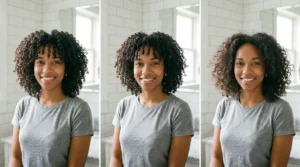
One wash isn’t always enough. Humidity, buildup, technique, haircut, and previous heat styling can temporarily affect curl definition.
Take photos after two or three normal wash days. The repeated pattern will give you a more reliable answer than a single strand.
Curl Type Is Not the Same as Hair Porosity
Curl type describes shape. Porosity describes how readily the hair takes in and loses water. Two people with 3B curls may need completely different routines because one has low-porosity hair and the other has more porous, chemically treated hair.
Other characteristics to consider include:
- Strand thickness: Fine strands are easier to weigh down and may need less product.
- Density: Dense hair may require sectioning for even cleansing and conditioning.
- Porosity: More porous hair may absorb products quickly but still lose moisture easily.
- Scalp condition: Oiliness, flakes, sensitivity, and buildup should influence washing frequency.
- Hair condition: Bleaching, frequent heat, and chemical treatments can change how curls behave.
Avoid relying only on the popular water-glass or “float” test for porosity. Product residue, surface oils, and trapped air can affect how a strand behaves in water. Drying time, product absorption, tangling, and your hair’s response to conditioning usually provide more useful clues over time.
Curly Hair Care by Type

There is no single routine that works for every person within a category. Use your curl family as a starting point, then adjust for your scalp, porosity, and styling goals.
A Simple Type 2 Routine

Wavy hair often needs enough cleansing to maintain volume.
Apply shampoo mainly to the scalp, then use conditioner from the mid-lengths to the ends. Scrunch a lightweight mousse, foam, or gel into wet hair and avoid touching it repeatedly while it dries.
If the waves become flat, stringy, or greasy, try using less leave-in product before assuming the hair needs more moisture.
A Simple Type 3 Routine

Cleanse the scalp as needed and condition the full length of the hair.
Detangle gently while the hair is wet or damp and coated with conditioner. Apply a leave-in or curl cream, followed by gel if you want stronger definition. Styling on very wet hair can help curls clump together, while styling on damp hair may create more volume.
A Simple Type 4 Routine

Working in sections can make cleansing, conditioning, and detangling more manageable.
Use a moisturizing shampoo on the scalp and a conditioner with enough slip to separate knots without pulling. Apply a water-based leave-in before using a cream or butter if your hair benefits from richer products.
Oil can help reduce moisture loss or add shine, but it does not hydrate dry hair by itself. Water and water-based conditioning products provide moisture.
Low-manipulation styles can also help protect fragile ends, provided the style is not tight, painful, or pulling on the hairline.
The American Academy of Dermatology’s curly hair guidance recommends conditioning the full length of curly or coily hair and adjusting wash frequency to the needs of the scalp and hair. It also advises detangling carefully rather than brushing dry curls.
How to Adjust a Routine That Isn’t Working
Your hair’s response is usually more useful than the label on a product.
- Hair feels coated or curls look limp: Use less product or wash away buildup.
- Curls look fluffy but not defined: Apply stylers to wetter hair or use a product with more hold.
- Hair feels rough after washing: Try a gentler cleanser or a more effective rinse-out conditioner.
- Roots become oily while the ends remain dry: Focus shampoo on the scalp and conditioner on the lengths.
- White residue appears after styling: You may be layering too many products or combining formulas that don’t mix well.
- Curls feel stiff: Scrunch the hair gently after it is fully dry to soften the gel cast.
- Hair keeps snapping during detangling: Add more water and conditioner, use smaller sections, and reduce pulling.
Can Your Curl Pattern Change?

Curl patterns can look different after a haircut, during humid weather, or when you change your styling method. Removing damaged or heavy ends may allow curls to spring up more clearly, but the haircut itself does not create a new natural texture.
Frequent straightening, bleaching, chemical processing, and excessive heat can weaken the hair shaft and loosen the visible pattern. The AAD recommends limiting heated tools and using a low setting to reduce hair damage in its healthy hair-care guidance.
Hormonal changes, aging, some medications, and health conditions may also coincide with texture changes. If your hair changes suddenly alongside scalp pain, significant shedding, bald patches, redness, or severe itching, consult a board-certified dermatologist.
If you’re considering a color change, our guide to the best hair colors for green eyes can help you choose a flattering shade before discussing processing with your colorist.
Common Curl-Typing Mistakes
Trying to Make Every Section Match
Mixed patterns are normal. Use different amounts of product or slightly different styling methods on sections that behave differently.
Typing Hair While It Is Wet
Water stretches the hair. Judge your pattern after it has dried without being brushed or pulled straight.
Assuming Frizz Means the Curl Type Is Wrong
Frizz can come from humidity, dryness, damage, friction, styling technique, or insufficient hold. It is not a separate curl category.
Buying Products Based Only on a Number
A product labeled for Type 4 hair may be too heavy for someone with fine 4A strands. A lightweight product marketed to waves may not provide enough conditioning for coarse, porous 2C hair.
Choose products according to what your hair needs, not only the number printed on the label.
Ignoring the Scalp
Curl definition should not come at the expense of scalp comfort. Shampoo when your scalp feels oily, itchy, or coated rather than following a rigid schedule from social media.
Frequently Asked Questions
Can one person have two different curly hair types?
Yes. Many people have a mixture of waves, curls, and coils. The crown, hairline, and nape may each have a slightly different pattern.
Is 2C hair wavy or curly?
Type 2C is generally classified as wavy, but it often contains some loose spirals. It sits near the boundary between strong waves and Type 3 curls.
Does 4C hair have a curl pattern?
Yes. Type 4C hair has very tight coils or bends that may not look clearly defined without water or styling. Lack of visible ringlets does not mean the hair lacks texture.
Is hair porosity determined by curl type?
No. Wavy, curly, and coily hair can all have low, medium, or high porosity. Chemical processing, heat, weathering, and individual hair characteristics can influence porosity.
Can a curl cream change your natural curl type?
A curl cream can improve clumping, softness, or definition, but it cannot permanently change the pattern growing from your follicles. Chemical treatments and repeated high heat can alter the visible shape by restructuring or damaging the hair.
Should curly hair be brushed every day?
Usually not when it is dry. Dry brushing can separate curl clumps and increase pulling. Detangling damp hair with conditioner and a wide-tooth comb is often gentler, especially for tight curls and coils.
Final Takeaway
The 2A to 4C chart can help you describe your hair, but it should guide your routine rather than control it. Start with your general pattern, then pay attention to porosity, strand thickness, density, scalp comfort, and how your hair responds to products.
The best curl routine is not the one assigned to a particular letter. It’s the one that keeps your scalp comfortable, your strands manageable, and your natural pattern looking and feeling healthy.
Our Editorial Approach
Beauty and self-care information should be clear and easy to use. Our goal is to help you understand your options and make more informed choices about your everyday routine.
Our articles are for educational purposes only and do not replace advice from a qualified healthcare professional.