
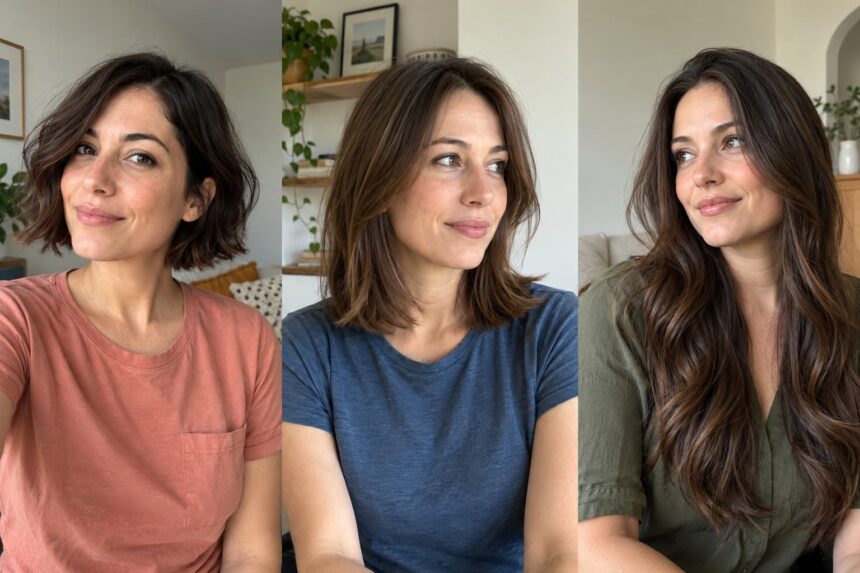
Shoulder-length hair sounds easy to describe until you sit down for a haircut. You might mean ends that brush the tops of your shoulders, while your stylist pictures a cut just above them. Add waves, curls, or shorter pieces around the face, and the finished length can look different again.
- Hair Length Chart at a Glance
- 1. Cropped Hair
- 2. Ear-Length Hair
- 3. Chin-Length Hair
- 4. Neck-Length Hair
- 5. Shoulder-Length Hair
- 6. Collarbone-Length Hair
- 7. Armpit-Length Hair
- 8. Mid-Back Hair
- 9. Waist-Length Hair
- 10. Hip-Length Hair and Beyond
- Hair Length Chart in Inches and Centimeters
- How to Measure Your Hair Length
- Start With Your Usual Texture
- Choose a Consistent Starting Point
- Measure Without Pulling Hard
- Record Where the Ends Fall
- How Texture Changes Visible Length
- Choose a Length That Fits Your Routine
- If You Usually Wear a Ponytail
- If You Prefer Minimal Styling
- If You Want Fuller-Looking Ends
- If You Like Changing Hairstyles
- Common Hair Length Chart Mistakes
- Final Takeaway
- Frequently Asked Questions
A hair length chart gives you a clearer way to compare styles. Chin, collarbone, armpit, and waist length describe where the ends fall on your body. Measurements in inches describe distance, but they don’t land at the same point on everyone.
Start with where you want your hair to sit when you normally wear it. Then consider the shape, texture, and amount of styling that will make that length work for you.
Hair Length Chart at a Glance
| Length name | Where the longest ends sit | Styles to compare | What to consider |
|---|---|---|---|
| Cropped | Close to the scalp or above the ears | Crop, short pixie, tapered cut | How much length you want on top |
| Ear length | Around the ears | Long pixie, short bob, bixie | Whether you want to tuck the sides back |
| Chin length | Around the jaw or chin | Classic bob, textured bob | How the front and back lengths differ |
| Neck length | Between the chin and shoulders | Longer bob, graduated bob | The shape around the nape |
| Shoulder length | At the shoulders | Shoulder-length cut, lob | Whether the ends rest on or clear the shoulders |
| Collarbone length | Around the collarbones in front | Long bob, layered cut | How the front connects with the back |
| Armpit length | Around the horizontal level of the armpits | Medium-long cut, soft layers | The balance between length and fullness |
| Mid-back length | Around the middle of the back | Long layers, U-shaped cut | How much weight you want through the ends |
| Waist length | Around the natural waist | Long blunt cut, long layers | Detangling and everyday handling |
| Hip length and beyond | At or below the hips | Extra-long cut, shaped perimeter | Time spent washing, drying, and styling |
These labels are visual guides rather than fixed measurements. Shoulder and collarbone length can overlap depending on your proportions, posture, and the shape of the cut.
1. Cropped Hair
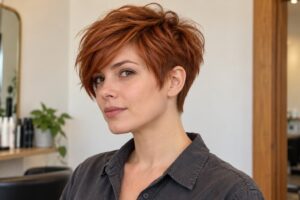
Cropped hair keeps most of the length close to the head, although the top may be longer than the sides and back.
Compare the outline as well as the length. A tapered crop gives a different shape from a pixie with a longer fringe.
Think about how you want the hair to sit without styling. A reference photo with similar texture can help you explain that preference.
Short hair may take less time to dry, but a precise shape can need regular trims to keep its outline.
Best for: A short style with a clearly defined shape.
2. Ear-Length Hair
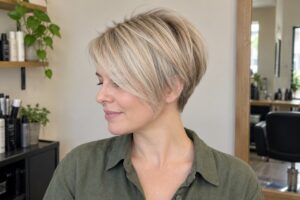
Ear-length hair falls around the ears, with room for variation through the fringe, crown, and nape.
A longer pixie can keep movement on top, while a very short bob creates a more continuous outline.
Tell your stylist whether you want to tuck the sides behind your ears. That detail may change how much length needs to remain.
Check the back view before choosing. Two styles that look similar from the front may have very different nape lengths.
Best for: A short cut with some movement around the face.
3. Chin-Length Hair

Chin-length hair places the ends around the jaw or chin.
A blunt bob gives a defined edge. Soft layers or textured ends create a less solid outline.
Decide whether the front should reach the chin or whether the whole perimeter should sit near that level. An angled bob can be longer in front and much shorter behind.
If you wear your hair wavy or curly, discuss where the ends should sit once dry.
Best for: A bob with a noticeable shape around the jaw.
4. Neck-Length Hair

Neck-length hair sits between the chin and shoulders.
It gives you more length than a short bob without reaching a shoulder-length cut.
Compare the shape at the back. A graduated bob can sit higher at the nape, while a one-length cut leaves a more even perimeter.
Check whether the ends fall against your usual collars or scarves. That contact may affect how they sit during the day.
Best for: A longer bob that still stays above the shoulders.
5. Shoulder-Length Hair

Shoulder-length hair reaches the shoulders, but the exact finishing point matters.
Ends that rest directly on the shoulders may bend outward. A cut slightly above or below them can sit differently.
Show your stylist where you want the finished ends to fall. “At my shoulders” leaves more room for interpretation than pointing to a specific place.
If tying your hair back matters, ask whether the front sections and layers will reach the tie as well.
Best for: A medium length with several styling options.
6. Collarbone-Length Hair

Collarbone-length hair reaches around the collarbones when viewed from the front.
It’s a useful reference for a longer bob or a medium cut with some length around the face.
Decide whether you want a solid edge, soft layers, or shorter face-framing pieces. Each changes the overall appearance without necessarily changing the longest length.
Check a front and back reference together so the full shape is clear.
Best for: A medium cut with length below the jaw and neck.
7. Armpit-Length Hair

Armpit length describes hair that reaches approximately the level of the armpits.
It offers more length for braids, ponytails, and pinned styles, although shorter layers may still fall loose.
A blunt perimeter keeps more visual weight at the bottom. Layers create variation through the lengths.
Consider how full you want the ends to look before deciding how much layering to add.
Best for: A medium-long style with room for tied-back looks.
8. Mid-Back Hair
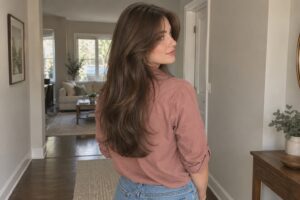
Mid-back hair falls around the middle of the back.
It leaves space for long layers, a rounded U-shaped edge, or a straighter perimeter.
Compare photographs from behind. Front-facing pictures can hide how much length sits at the back, especially when the hair is brought over the shoulders.
Ask how the chosen shape will look in your usual texture rather than only after a salon blow-dry.
Best for: Long hair with a clearly shaped back outline.
9. Waist-Length Hair

Waist-length hair reaches approximately the natural waist.
Choose the finishing point on your own body instead of relying on another person’s measurement.
You can keep the ends relatively solid or add long layers for variation. Shorter front sections will still sit well above the overall length.
Consider how you handle your hair during sleep, exercise, and daily activities before choosing this length.
Best for: A distinctly long style with several ways to arrange it.
10. Hip-Length Hair and Beyond

Hip-length hair reaches the hips, with longer categories extending farther down the body.
At this length, everyday handling becomes a bigger part of the choice. Think about washing, drying, detangling, and keeping the lengths out of the way.
Discuss whether your priority is preserving maximum length or keeping a fuller-looking perimeter.
A small trim and a large shape change are different requests, so be specific about how much you’re comfortable removing.
Best for: An extra-long style that fits your care routine.
Hair Length Chart in Inches and Centimeters
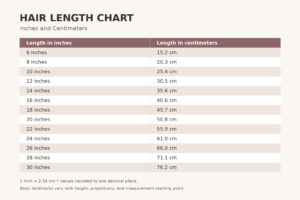
Inches are useful when you know where the measurement starts. They don’t provide a universal match for chin, shoulder, or waist length.
| Length in inches | Length in centimeters |
|---|---|
| 6 inches | 15.2 cm |
| 8 inches | 20.3 cm |
| 10 inches | 25.4 cm |
| 12 inches | 30.5 cm |
| 14 inches | 35.6 cm |
| 16 inches | 40.6 cm |
| 18 inches | 45.7 cm |
| 20 inches | 50.8 cm |
| 22 inches | 55.9 cm |
| 24 inches | 61.0 cm |
| 26 inches | 66.0 cm |
| 28 inches | 71.1 cm |
| 30 inches | 76.2 cm |
A 20-inch measurement from the crown won’t finish at the same point as 20 inches measured from a lower extension attachment.
Body proportions also change the result. Extension brand Luxy Hair notes that the same extension length can fall differently on people with different torso lengths.
Use the number together with a measurement on your own body.
How to Measure Your Hair Length
Start With Your Usual Texture
Let your hair sit the way you normally wear it.
If your goal is a curly shoulder-length cut, first identify where the curls fall naturally. A stretched measurement answers a different question.
You can record both, but label them clearly.
Choose a Consistent Starting Point
For tracking your own growth, choose a specific starting point and use it each time.
For example, measure a selected section from its root to the end, noting where that section comes from.
For wigs or extensions, follow the seller’s measurement method. Don’t assume every product starts from the same place.
Measure Without Pulling Hard
Use a flexible measuring tape and keep your posture consistent.
If recording stretched length, gently extend the section rather than pulling it tightly.
Ask someone to help when measuring the back. Turning your head to read the tape can change the position.
Record Where the Ends Fall
Take a back-view photo and note the body landmark as well as the measurement.
Use a similar angle, hairstyle, and clothing neckline when comparing later photographs.
This gives you a clearer record than changing between straight, curled, and stretched measurements.
How Texture Changes Visible Length
Straight, wavy, and curly hair can have the same stretched measurement but look different when worn naturally.
| Texture | What to check |
|---|---|
| Straight | Where the ends fall without bending or styling |
| Wavy | How much the waves lift the ends when dry |
| Curly | The difference between natural and gently stretched length |
| Coily | The finished shape and shrinkage in your usual routine |
There isn’t one extra number of inches that works for every curl pattern.
Discuss the dry finishing point before cutting. Show your stylist how you normally style your hair and how much variation you notice between wash days.
When shopping for textured wigs, check whether the listed length is measured stretched. Mayvenn, for example, describes measuring wigs from the crown to the ends with the hair pulled straight.
Choose a Length That Fits Your Routine
If You Usually Wear a Ponytail
Check the shortest sections, not just the longest ends.
A shoulder-length cut may leave enough length at the back while shorter layers fall around the face.
Ask for a cut that supports the height and placement of your usual ponytail.
If You Prefer Minimal Styling
Look for references with a texture close to your own.
A smooth salon photo may show a finish that requires more work than you want to do each morning.
Discuss how the cut is likely to sit after your usual washing and drying routine.
If You Want Fuller-Looking Ends
Compare the perimeter and layering as well as the overall length.
A shorter cut with a solid edge can look different from longer hair with heavily tapered ends.
Ask your stylist to show how much density would remain at the bottom.
If You Like Changing Hairstyles
Consider the styles you actually wear.
Braids, buns, waves, and half-up looks each use length differently. Bring examples of your everyday styles alongside your haircut reference.
Common Hair Length Chart Mistakes
Treating Body Landmarks as Exact Inch Measurements
Shoulder length isn’t one fixed number. Height, neck length, and the starting point of the measurement all affect the result.
Comparing Wet Hair With Dry Hair
The finished length may look different once the hair dries, particularly with waves or curls.
Forgetting About Layers
The longest ends don’t describe the whole haircut. Check the fringe, face frame, and shortest layers too.
Using Only a Front-View Reference
A front photo may hide a shorter back, an angled perimeter, or extra length behind the shoulders.
Assuming Short Hair Means Less Maintenance
Short hair can be quicker to wash and dry, but some shapes need frequent trims or daily styling.
Asking for “Two Inches Off” Without Showing the Result
Point to where you want the dry ends to sit. Confirm the amount being removed before the cut begins.
Final Takeaway
A hair length chart helps you describe where you want your hair to fall, but inches and body landmarks serve different purposes. Texture, layers, and the measurement’s starting point all change the result.
Choose the finished length on your own body, then discuss the shape and styling routine that go with it. A clear reference and a specific dry finishing point make the request easier to understand.
Frequently Asked Questions
What is a hair length chart?
A hair length chart compares lengths using body landmarks, measurements, or both. It helps describe a haircut, track length, or choose wigs and extensions.
What counts as medium-length hair?
There isn’t one universal definition. Shoulder and collarbone lengths are commonly described as medium, while longer lengths may be called medium-long.
How long is shoulder-length hair in inches?
There isn’t a single accurate number for everyone. Measure from a defined starting point to your own shoulders, or use the body landmark when discussing a haircut.
Where does 18-inch hair fall?
That depends on where the measurement starts, your proportions, and the texture. Measure 18 inches from the relevant starting point to estimate the result on yourself.
Should curly hair be measured stretched?
Record natural length if you want to describe how it looks when worn curly. A gently stretched measurement is useful for other comparisons. State which method you’re using.
Do layers make hair shorter?
Layers shorten selected sections. You can keep the longest perimeter while cutting shorter pieces through the rest of the hair.
Which hair length is easiest to maintain?
It depends on your texture, haircut, and styling habits. Consider drying time, detangling, trims, and whether you want to tie it back.
What should I ask for at the salon?
Describe the dry finishing point, shape, and shortest sections. For example: “Collarbone length when dry, with a solid perimeter and front pieces long enough to tuck behind my ears.”
Our Editorial Approach
Beauty and self-care information should be clear and easy to use. Our goal is to help you understand your options and make more informed choices about your everyday routine.
Our articles are for educational purposes only and do not replace advice from a qualified healthcare professional.